 Bora Bora Snorkeling
Swimming with Sharks and Stingrays in Bora Bora
Every snorkel boat in Bora Bora sells some version of the same promise - swimming with sharks and stingrays in Bora Bora - and every traveller quietly wants to know what that actually means before their feet leave the ladder. This guide answers with the species you will meet, the water you will meet them in, the law that reshaped the encounters in 2017, and the way good guides run a sandbar. When the species make sense, the boats sort themselves quickly: the Bora Bora shark-and-ray tour comparison lines up every listing that makes the swim.
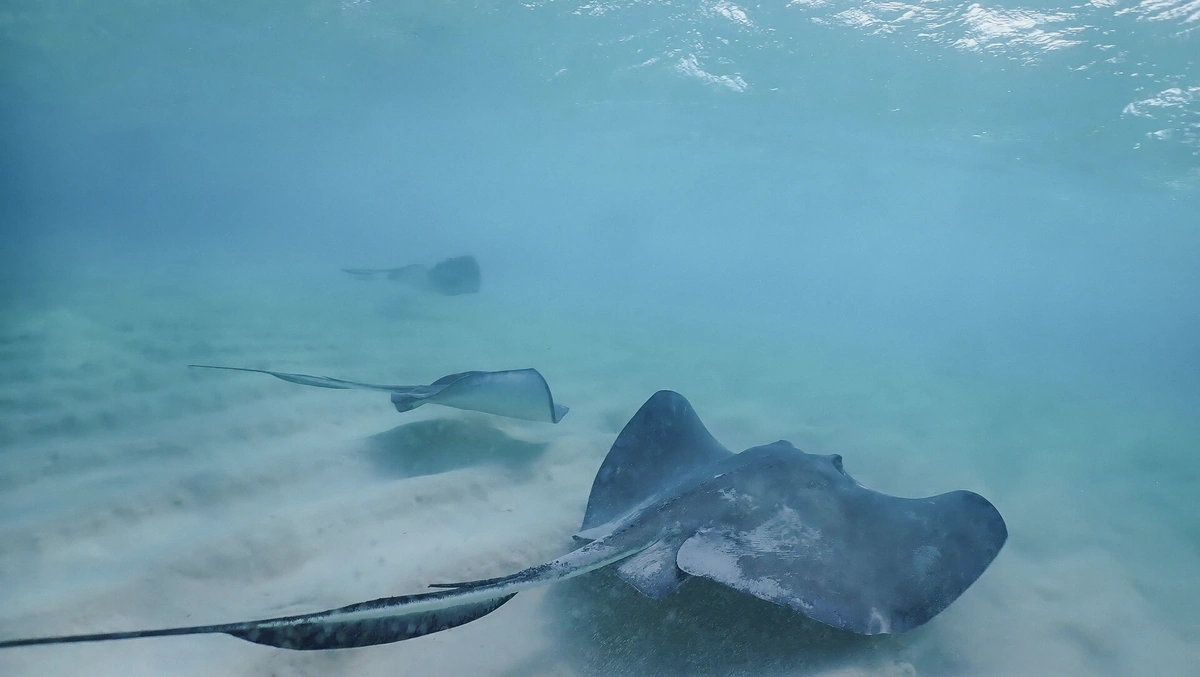
The sandbar's residents: stingrays working the shallow flats - the encounter every postcard is taken at. Photo: Wikimedia Commons - see notes/commons-attribution.json. Illustrative photo: stingrays on a shallow sandbar, Grand Cayman.
Quick answer Which sharks and rays you meet, how deep the water is, and the one law that changed the encounter
Swimming with sharks and stingrays in Bora Bora means three species and one depth: stingrays and small blacktip reef sharks in knee-deep water on the sandbars, occasional lemon sharks passing deeper sites, and encounters in waist-to-chest water under a guide's supervision. Feeding the animals has been illegal in French Polynesia since October 2017, so the animals are there because the habitat suits them - and the guides' rules (stand still, hands closed, no chasing) do the rest. It is the calmest headline wildlife encounter in the Pacific.
Key takeaways
- The boat that runs the longest supervised shark-and-ray stop: the Moana eco cruise - 1 h 40 min in the shallows.
- The strictest wildlife policy in the lagoon: H2O's no-feeding route, which skips even the historically fed sites.
Blacktip Reef Sharks: The Lagoon's Resident Shark
The blacktip reef shark is the animal behind the promise: a slim, bronze-backed shark with the namesake fin tips, typically 1 to 1.5 metres long in the lagoon, and - the part that matters on a first swim - a cautious animal that keeps its own distance. Blacktips patrol the sandbars' deeper edges and the reef flats, hunting small fish at dawn and dusk; on the snorkel stops they cruise through at arm's-length-plus, ignore swimmers who stand still, and leave the water warmer for the meeting. Their species page carries the biology; the lagoon experience is smaller and calmer than the word shark promises.
What blacktip encounters are actually like
Predictable, brief and photogenic.
- Depth: the sharks cruise in waist-to-chest water along the sandbar's edge - swimmers stand shallow, sharks pass deep
- Behaviour: circuit patrols at a slow cruise; sudden moves are made by fleeing fish, never by the shark
- Group dynamics: ones and twos on the sandbars, larger patrols on the reef flats - reviewers count four or five circling a busy stop
- The rule: do not reach, do not chase, do not block their line - the same rules a stingray wants
The Stingrays: Residents of the Shallow Flats
The lagoon's stingrays are the encounter's gentle giants - broad, velvet-backed rays that glide across the warm flats and, on the busiest sandbars, cruise right up to standing swimmers with the confidence of animals that have met a thousand polite tourists. They are wild animals with wild-animal hardware: a barb at the tail's root, used defensively, never offensively. The encounter's grammar is therefore simple and the guides enforce it before anyone enters the water: shuffle, do not step; stand still and let the ray come; hands closed; never grab, ride or lift - the guide's briefing on respect for animal life before anyone enters the water.
Run that way - and Lagoon Service's listings show they all run that way - the stingray stop is the trip's softest and best moment.
How the good guides run a sandbar
The pattern across the comparison's listings and reviews.
- Briefing before the water: encounter rules, barb honesty, where to stand, what a passing ray wants (nothing from you)
- Guide in the water: H2O's crew stands with the group, reads the animals, and calls the moves
- Small circles: swimmers form a loose ring, rays cruise the middle - the animals set the distance, not the tourists
- Exit before exhaustion: the best crews end the stop while the group is still fresh, which keeps the next swimmer's ray just as calm
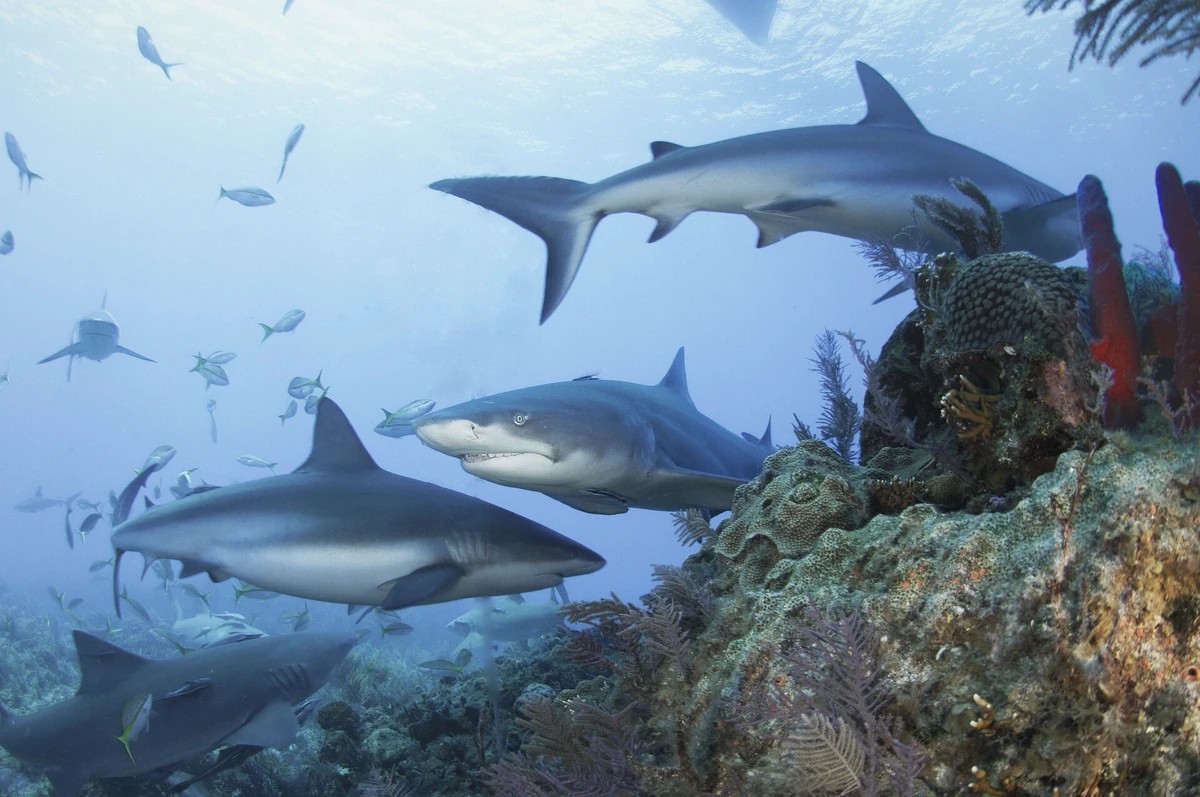
The deeper-water visitor: a lemon shark - occasionally passed on the reef-edge stops, seen and not chased. Photo: Wikimedia Commons - see notes/commons-attribution.json. Illustrative photo: lemon shark among Caribbean reef sharks.
Lemon Sharks: The Deeper-Water Bonus
Lagoon Service's listing names the lagoon's full cast - from stingrays to blacktip sharks and lemon sharks - and the lemon is the second shark a Bora Bora week can produce. Larger and stockier than the blacktips, lemon sharks work the deeper sandy zones and the reef edges, and snorkellers meet them as a passing silhouette rather than a circling encounter: the animal crosses, the group watches, the guide notes it and moves on. Reef Discovery reviewers count lemon sharks among a February trip's highlights; nobody in the record describes one approaching a group. They are the lagoon's reminder that the ecosystem is real - seen at the edge of the water you actually swim in.
Tiger bulls and other things people ask about
The honest geography: Bora Bora's swimming encounters happen inside a shallow, closed lagoon, and the species that make the open-ocean headlines - tiger sharks, the oceanic roamers - live outside the barrier in deep water, not in the swim bands. No encounter in this comparison's listings, and none in the reviews behind them, involves anything but blacktips, lemons and rays. The dangerous-animal questions answer themselves with the map: the sandbars are knee-deep, the guides are standing in them, and the animals that live there are small ones.
The 2017 Feeding Ban: The Law Under the Encounter
The single most important fact about Bora Bora's wildlife encounters is legal: shark and ray feeding has been illegal in French Polynesia since October 2017. Before the ban, boats brought food to the sandbars; since it, the animals gather because the habitat suits them - warm shallow water, tide-delivered food, safety - and the encounter is a meeting rather than a feeding. Operators state their line on their listings: the H2O half-day writes that it does not partake in feeding and avoids every site where animals are artificially attracted; the Rohivai safari puts feeding on its not-allowed list; the Lagoon Service tour commits to respect for the natural unspoilt environment.
The result underwater is wild animal behaviour - rays that approach out of curiosity, sharks that keep their distance - which is the entire point.
Why the ban made the encounter better
Feeding concentrates animals unnaturally, trains them to associate swimmers with food, and drags the species into the exact behaviours - crowding, grabbing, jostling - that turn an encounter into an incident. The ban emptied the incentive out of all of it. What a visitor notices in 2026: animals arrive on their own schedule, in natural numbers, with natural manners - and the guides' jobs shifted from managing a feeding frenzy to reading a wild sandbar, which is a better show.
Safety, Honestly: Risks, Rules and Real Numbers
The safety case for a guided Bora Bora sandbar swim rests on four legs: the species are small and cautious; the water is shallow and calm inside the barrier reef; the guide is in the water with the group; and the rules - briefed before every swim - remove the behaviours that cause injuries everywhere in the world. Stingray injuries happen when a ray is stepped on or grabbed; shark incidents worldwide concentrate in open-ocean activities, not waist-deep guided swims. The honest risks on a Bora Bora snorkel day are sunburn and a stubbed toe - which is why the packing list leads with sunscreen and water shoes.
The rules that keep it that way
Every listing briefs versions of the same five.
- Stand still and let animals pass - pursuit is the behaviour that breaks encounters
- Hands closed: no touching, no grabbing, no riding - for the animal's safety as much as yours
- Shuffle your feet on sand, fin slowly over reef - the stingray's barb is defensive and ground-level
- Stay with the guide's circle - the formation is the safety system
- Report discomfort early - H2O's crews' reviews are full of mid-swim adjustments for exactly this
Who should think twice
The listings draw their own lines: not recommended for pregnant travellers (Moana), medical certificates for over-70s (H2O), not suitable over 80 (H2O), mobility exclusions across several listings. None of the exclusions is about the animals - they are about ladders, lurches and deep-water confidence - and the rules each Bora Bora snorkel boat prints on its listing.
Reading ray posture: the five positions
A stingray's posture is its sentence, and the sandbar speaks it plainly. Flat on the sand: resting - give it the space. Wing-tips raised like a berth: digging - watch the sand plume, keep your feet shuffling.
Gliding level through the ring: commuting - the moment cameras live for. Wings rolled at the edges: curious - it may approach you, and holding still is the invitation. Tail flicked or the disc tilted toward you: patience failed - back up a step and the sentence erases itself.
Learn those five and the sandbar stops being a crowd of animals and becomes a room of conversations, most of which the ray opens.
Choosing the Encounter That Fits You
Seven boats run versions of this swim; three fit most travellers. The longest supervised shallows time belongs to the Moana eco cruise - an hour and forty minutes in knee-deep water with the briefing done properly. The strictest wildlife line is H2O's no-feeding route, which pairs the sandbar-free doctrine with the manta grounds.
And the family-format version - fruit, drinks, dock-to-dock transfers - is the the Rohivai half-day. For the field beyond those three, the lagoon's boats, compared page runs the full table.
The species-to-boat match
What you came for, and the boat that delivers it.
| You want to meet | Water | The listing that runs it |
|---|---|---|
| Stingrays at arm's length | Knee-deep | the Moana eco cruise - 1 h 40 min on the ground |
| Blacktips, calmy | Waist-to-chest | the Lagoon Service outrigger - shallow-only stops |
| Lemon sharks passing | Deeper reef edge | the Reef Discovery half-day |
| Wild behaviour, no feeding sites | Mixed | H2O small-boat |
The Species Ledger: Who Lives Where in the Lagoon
A Bora Bora snorkel week can realistically produce five named animals, and each lives in a band of the lagoon a swimmer can describe with their feet. The sandbars hold the stingrays and the juvenile blacktips; the flats carry the eagle rays; the channel edge hosts the mantas and the passing lemon sharks; and the coral gardens hold the residents - moray eels in their holes, octopus changing colour against the rock, and the anemone fish that guard them. The listings name the same cast from boat to boat; what changes is which band the boat works and how long it stays.
The table puts the ledger in one place, and the Bora Bora shark-and-ray tour comparison attaches it to the boats.
The ledger, band by band
Where each animal lives, and the odds a week's swimmer meets it.
| Animal | Band | Depth | A week's odds |
|---|---|---|---|
| Stingrays | Sandbars | Knee-deep | Near-certain |
| Blacktip reef sharks | Sandbar edges, flats | Waist to chest | Near-certain |
| Eagle rays | Southern sandy flats | 2-5 m | Frequent |
| Reef mantas | Eastern channel edge | 4-8 m | Common on manta routes |
| Lemon sharks | Deeper sand, reef edge | 5 m plus | Occasional sightings |
| Moray eels, octopus | Coral gardens | 2-3 m | Common where guides point |
Stingray encounter anatomy: from ladder to sandbar
The signature minute deserves a slow walk-through, because every good briefing follows the same shape. You enter from the boat's ladder into waist-deep water over bright sand and stand still - that is the whole first instruction, because a still swimmer reads as a reef post and a moving one reads as something to investigate or flee. The guide calls the group into a loose ring.
The rays arrive on their own line: a wing breaks the surface, then the flat diamond body glides past at the distance you kept, close enough to see the breathing spiracles opening. A blacktip crosses the ring's deeper edge behind them. Nobody reaches; the rays stay anyway; and the moment photographers chase for years happens unforced.
Then the guide moves the group on while the animals are still calm - the timing that separates the good crews from the crowded ones.
What the feeding ban changed, in practice
Read the 2017 ban through a swimmer's eyes and it changed three things. The animals stopped arriving in a feeding rush - the old bait-ball chaos the older reviews describe - and returned to habitat numbers and habitat hours. The guides stopped being feeders and became interpreters, which is why the briefings carry natural-history notes rather than feeding instructions.
And the operators split on strictness: most boats visit natural gathering sites, while Lagoon Service's listing refuses even the sites that were historically fed - the strictest reading of the law's spirit, and the reason its route runs to wild grounds instead. Every version of the encounter you can book on this island in 2026 sits downstream of the ban, and every one is calmer for it.
Baby Sharks and the Nursery Question
Guests on the sandbar stops regularly meet blacktip reef sharks small enough to fit in a bathtub - juveniles working the warmest, shallowest water - and the question follows: is this lagoon a nursery? The honest answer is that the shallows serve that role for several reef species, and the sandbars' calm, food-rich margins are where the smallest sharks cruise. For the swimmer, the juveniles change nothing about the rules and everything about the texture: a palm-length blacktip patrolling ankle-deep water is the encounter at its most disarming, and the reason first-timers' reviews keep circling the same phrase - smaller than expected, calmer than imagined.
The adults patrol the deeper edge; the young ones own the flat; and neither has interest in a standing swimmer.
The night shift: who hunts when the boats go home
The lagoon the tours see is the day shift. When the light goes, the sandbars' grazers move off the flats and the predators' patterns change - blacktips hunt the edges more actively at dusk and through the night, the eagle rays raid the flats in looser groups, and the gardens' resident octopus and eels do their hunting from the rocks. Nothing about that shift threatens a daytime swimmer; it explains the daytime behaviour instead.
The animals you meet at ten in the morning are working rest shifts in water that feels safe to them, which is the whole reason the encounter runs on stillness and distance - the sandbar etiquette is not etiquette at all, but the terms of visiting a working night shift on its coffee break.
The Turtle Clause
Green sea turtles are not on the sandbar cast list, but they are the lagoon's most requested bonus animal, and the reviews record them honestly: a turtle surfacing beside the boat, or drifting over the garden at the second stop, lands in a handful of reviews across every operator here. Where the boats reliably meet them is the bay by the northern resort rows - one Reef Discovery reviewer describes the morning's first stop as turtles in the bay before the mantas - but no listing promises them, and the honest expectation is a one-in-several-mornings bonus rather than a stop. The rules when one appears: the turtle sets the terms, at the surface it needs its own air more than your photograph, and the ten-metre courtesy the guides ask for the rays applies double.
Snorkellers who want turtles on the record should say so at booking - crews know the season's reliable bays and will route a wish when the water allows.
Sharks and Stingrays in Bora Bora: FAQ
Is it safe to swim with sharks and stingrays in Bora Bora?
In the guided, shallow-water format every listing here runs, yes: the species are small and cautious (blacktips 1-1.5 m, stingrays defensive only), the water is knee-to-chest deep, the guide swims with the group, and the rules remove the touching and chasing that cause injuries. The honest risks are sun and reef stubs, not animals.
What sharks live in the Bora Bora lagoon?
Blacktip reef sharks are the resident species - seen on nearly every sandbar stop - and lemon sharks pass the deeper sandy zones and reef edges. Both are shy around swimmers. The open-ocean species live outside the barrier reef, not in the lagoon's swim bands.
Why do stingrays gather in shallow water in Bora Bora?
Because the habitat suits them: warm, food-rich flats with few predators and constant tide-delivered food. Since the 2017 feeding ban they gather for habitat reasons only - which is why encounters now follow wild-animal logic: arrive quietly, stand still, and the rays come to you.
Is shark feeding allowed in French Polynesia?
No - it has been illegal since October 2017 across French Polynesia. The operators' listings carry the doctrine: H2O avoids even the historically fed sites, Rohivai lists feeding among its not-allowed rules, and the encounter you swim in 2026 is a habitat meeting, not a feeding.
Do you need to be a strong swimmer for the shark and ray stops?
No - the signature stop runs in knee-deep water you can stand in, vests are available on most boats, and the guide is in the water throughout. The deeper reef-edge stops need basic confidence; for shallow-only formats, the outrigger and the Moana eco cruise stay inside stand-up depth.
Are there crocodiles or dangerous sharks in Bora Bora?
No crocodiles - French Polynesia has none - and the lagoon's sharks are the small, cautious reef species above. The animals that make the open-ocean headlines live outside the barrier in deep water, which is where the whale boats go, not where the snorkel boats swim.